
Beyond Rules and Fiction: The Many Ways We Find Fun
Finding new ways of playing roleplaying games

People have varying abilities to become absorbed in an activity depending on their personality type, their current state of mind, and the group they are participating in. Some people can easily shift between different forms of engagement, while others have a clearly preferred play style.
What is noteworthy, however, is that these forms of engagement can trigger one another—either because the person themselves enjoys a particular activity, or because they see others having fun and becoming engaged through their preferred play styles.
Many people have attempted to classify different player types, from Richard Bartle (player types), Mark Rosewater (player types in Magic: The Gathering), and Nicole Lazzaro (Four Keys of Fun) to Roger Caillois (Man, Play and Games), Marc LeBlanc (Eight Kinds of Fun), and Jason VandenBerghe (Five Domains of Play).
I have sorted these, and many more, into five different WHYs (why to play the game). These can be combined with five WHATs (what to play with) to create a total of 25 different play styles.
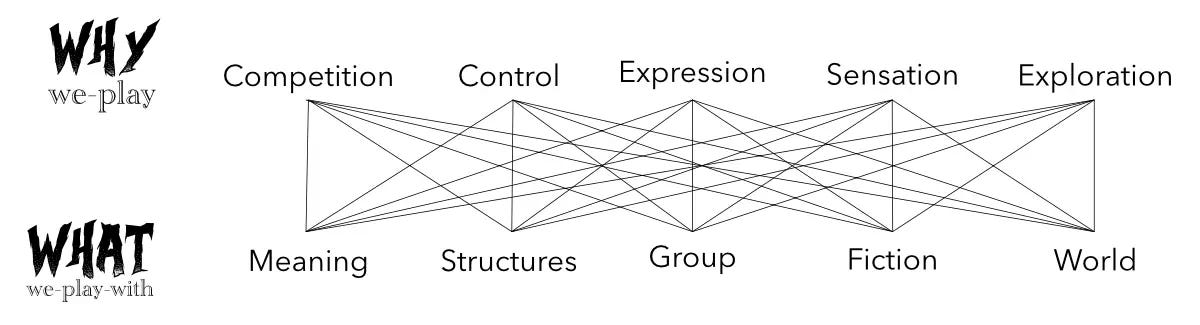
Everyone has different levels of preference for these categories. Perhaps three of them are things we enjoy at 100%, while another four appeal to us at around 50%. These preferences change over time and also depend on our current emotional state. Sometimes we may simply want to slaughter goblins, while other times we may want to explore what cancer does to a family to process something we are experiencing in real life.
As a game designer, you can even use this to come up with new ways of playing roleplaying games. Which core loops are required to explore the group? How can you home in on the sensation of meeting the structures of the game?
WHY
Competition: attempting to overcome the game or outperform other participants in different aspects of the game.
Control: the desire to lose control in a controlled environment or to master, dominate, or break. For example, breaking a game’s systems through powergaming.
Expression: expressing yourself through different forms of media within the game.
Sensation: seeking an experience, escapism, an “aha!” moment, or the opportunity to see life from different perspectives. Figuring out the plot or understanding a culture are two examples of sensation: the feeling you get at the end of a task.
Exploration: discovering and learning about different parts of the game, or discovering emergent outcomes created by the interaction of all its components. The journey is more important than the end.
WHAT
Meaning: philosophical, ethical, spiritual, cultural, and social questions.
Structures: game mechanics and techniques in the form of pools, procedures, triggers, and how communication happens within the game.
Group: all participants and their relationships with one another.
Fiction: the story created as part of play, because we interpret situations by placing them into a larger context.
World: the place where the story takes place and where all the characters exist.
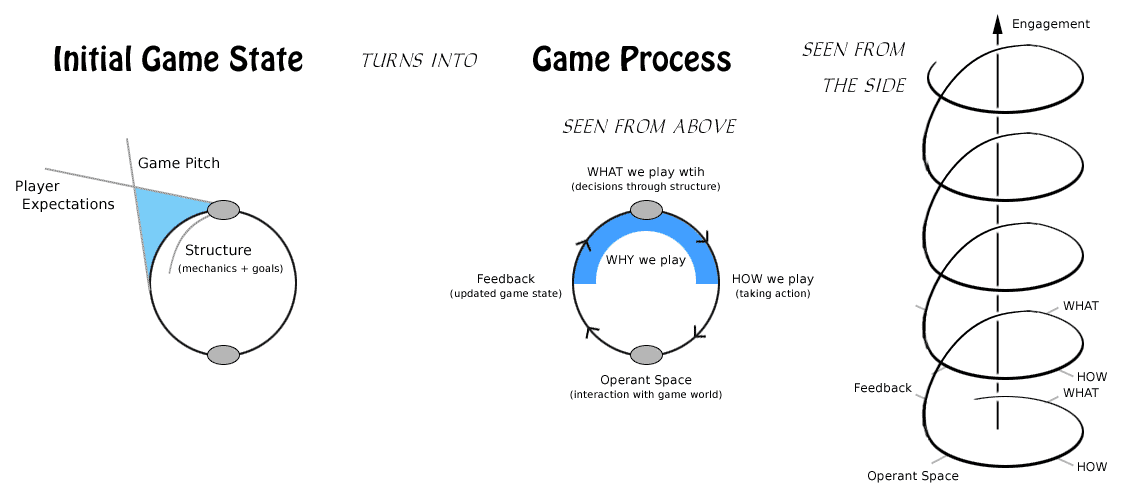
Even the world’s best-designed loop may fail to activate if it does not appeal to what a player finds enjoyable. Tangible reward mechanisms can be used to overcome initial resistance and encourage players to engage with an activity until they begin to enjoy the activity itself.
Note: scientific research has also shown that tangible reward systems may reduce the enjoyment of an activity when the motivation to receive the extrincic reward (ex. XP) becomes stronger than the intrinsic enjoyment of doing the activity in itself.What is required for the game is that it has a strong pitch: a pitch that communicates why someone should play the game and what they can expect from it.
The pitch not only establishes an initial understanding of the game; it also filters out people whose preferred play styles or forms of engagement do not match what the game is designed to provide.
In roleplaying games, we have session zero, where participants should clearly learn what the game is about, or where they have an opportunity to influence what the group will play so that their preferred forms of engagement are represented.
Creating a mental model of the game before play begins helps participants become more engaged during the actual session.
In this series:
Beyond Rules and Fiction: What Makes Games Different From Stories
Beyond Rules and Fiction: The Many Ways We Find Fun
Beyond Rules and Fiction: A Diagnostic Tool for Debugging Engagement
Beyond Rules and Fiction: The Future of Roleplaying Game Design