
Beyond Rules and Fiction: How Players Create Reality
The shared game space is reflected in the player's mind

I’m going to explore how the way people process information can be used to create engagement. Understanding this helps game masters develop techniques and methods, helps game designers shape how experiences emerge in the player’s mind, and helps players think about how their own actions can make the game more enjoyable for everyone else.
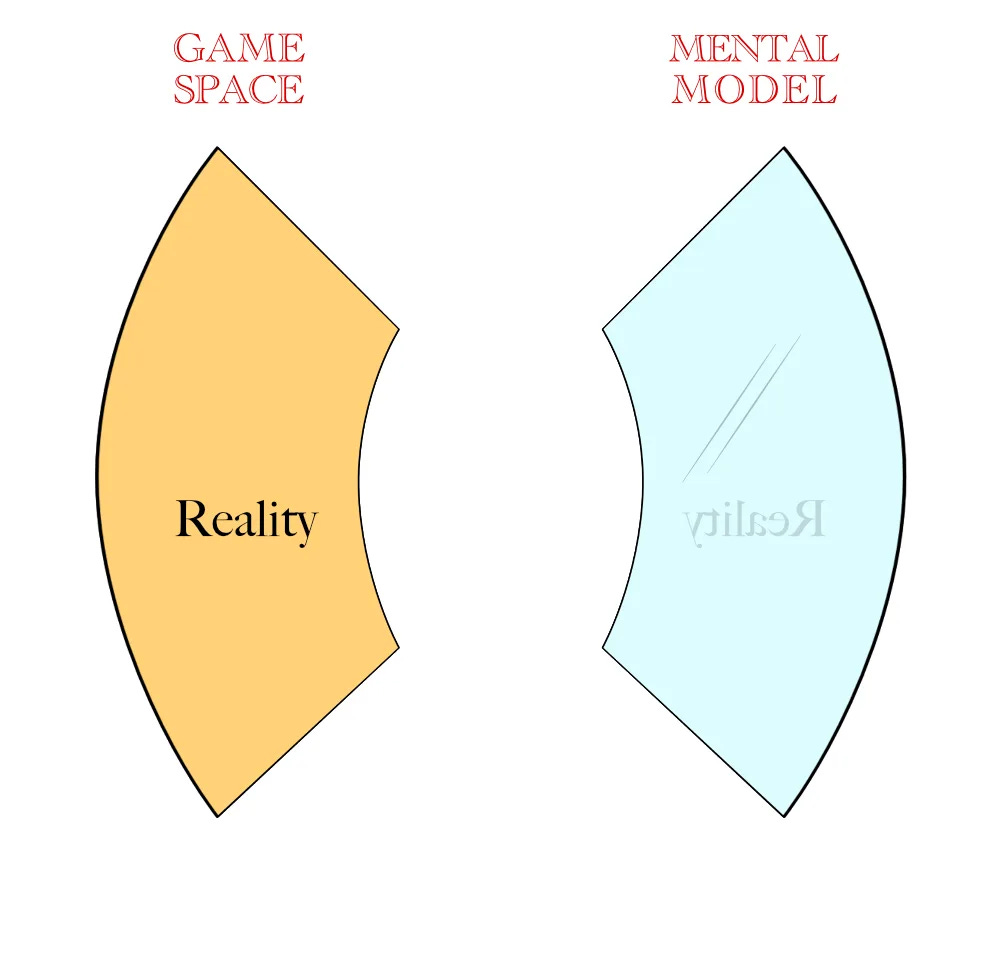
We construct an internal representation of reality. Our brains interpret the world, constrained by what our senses perceive as well as by our previous interpretations and experiences. A child who has only seen chickens before may see ducks and conclude that they, too, are chickens.
Below are some of the components that I believe exist both in the game space and in the player’s mental model.
Game Space
Pitch: establishes expectations and an initial understanding
Game world: genre, tone, themes, etc.
Conflicts within the setting or adventure
Participants: "Hanna always runs horror", "Simon loves deep character acting"
Mechanics: abilities, dice systems, reward structures, etc.
Previous stories: adventures and character backstories
The game board: maps, miniatures, etc.
The current session: everything that has happened and is happening
Controls: how players interact with the game, usually through their characters
Mental Model
Judgement / Conclusions: “What is happening and why?”
Motivation: play style, character goals, etc.
Expectations: about the game, the adventure, or the current situation
Social perception: what role each person plays within the group
Identity: gender roles, spirituality, ideology, and so on
Prior experience: games, groups, tropes, play styles, adventures
Perspectives: character perspective, player perspective, group interests
Planning: priorities, decision-making, resource management, etc.
Meaning-making: placing events into the context of a story
What I refer to as “reality” depends somewhat on the type of game being played. In a miniature game played on a physical board, everyone shares essentially the same visual representation. In a purely narrative roleplaying game, however, every participant constructs their own version of reality as part of a shared daydream.
Because everyone imagines the world slightly differently, misunderstandings naturally arise. But these are not necessarily a bad thing. On the contrary, they can become part of the experience—what a friend of mine calls creative misunderstandings.
In collaborative storytelling, participants often introduce characters, places, or events without having any particular plan for why they matter. The idea then gains momentum when the other participants build upon it using their own interpretations and imagination. Every participant, therefore, becomes a source of uncertainty. My current gaming group uses this deliberately for culture gaming: we invent the culture of a setting during play, while our characters explore it at the same time.
Mysteries work in much the same way. As the characters progress through the scenario, the game master reveals more and more clues. Which clues are presented—and when they are presented—determines the conclusions that players draw as they attempt to connect them. The game master can run several underlying storylines simultaneously. This makes it possible for players to misinterpret clues and connect them to the wrong storyline. In other words, the players’ own reasoning introduces uncertainty into the game when they unintentionally create their own red herrings.
In this series:
Beyond Rules and Fiction: How Players Create Reality
Beyond Rules and Fiction: What Makes Games Different From Stories
Beyond Rules and Fiction: A Diagnostic Tool for Debugging Engagement
Beyond Rules and Fiction: The Future of Roleplaying Game Design