
Beyond Rules and Fiction: The Constant Rewrite of Reality
Novelty, relevance, surprise, and complexity sparks an interest

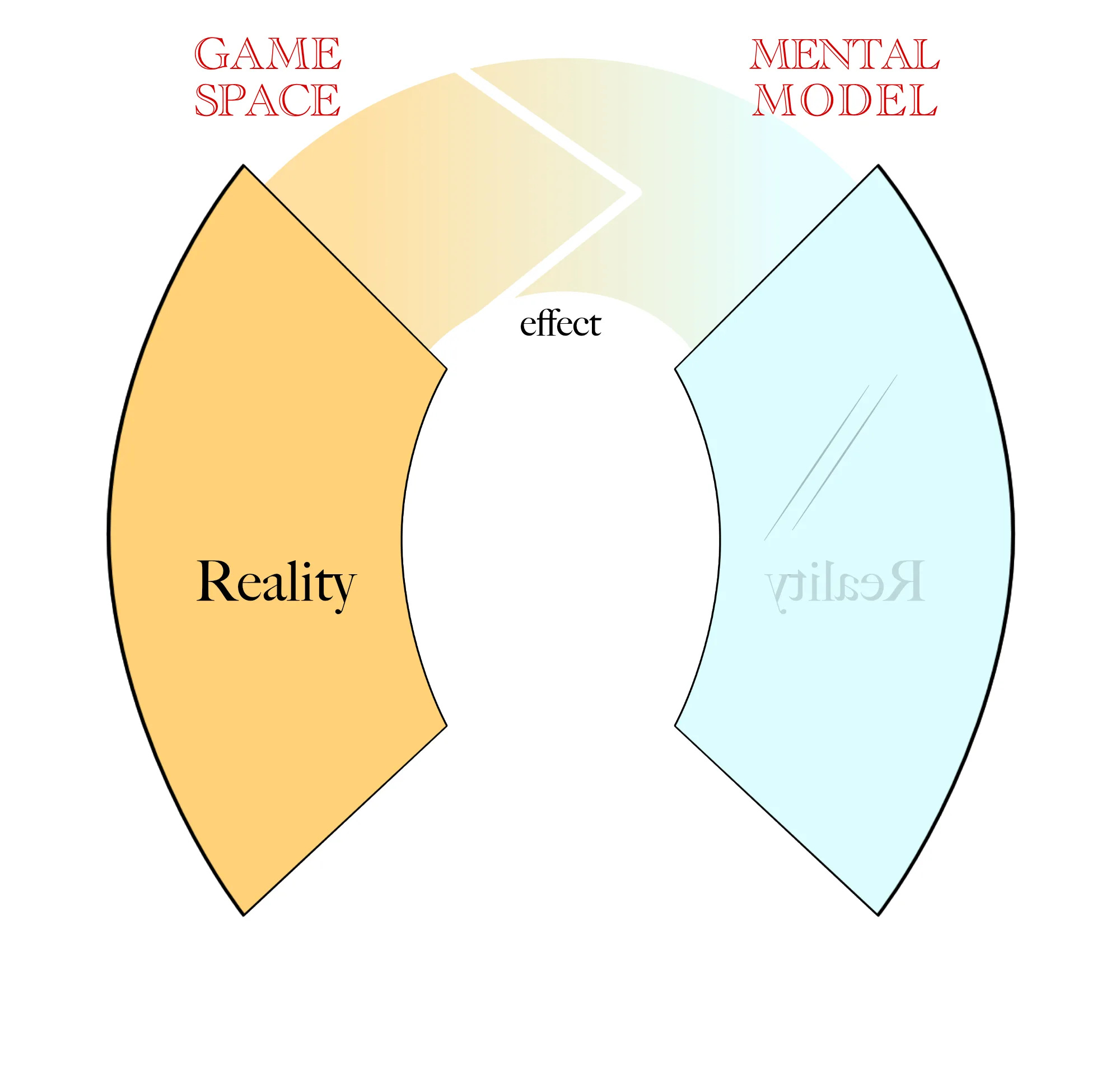
When we play, the game space is constantly being updated through the participants’ descriptions, the game’s mechanics, and the game master’s preparation. Each of these changes creates an effect that requires every participant to update their internal model of the game world.
The new information is evaluated in terms of its relevance to the character, the player’s preferred play style and motivations, their identity, previous events (for example, the healer was badly injured), the different layers of perspective from which the player can make decisions (”Should I act as my character would, as I personally would, or in the group’s best interest?”), and countless other factors that shape how the information is interpreted.
Most of the time, these mental updates happen effortlessly. “A yellow car? All right.” But if you want to engage the player more deeply, the information can serve as one piece of a larger puzzle. The more interconnected the puzzle becomes—the higher the complexity—the more thought the player must invest in making sense of it.
Players can also be surprised by presenting ordinary things that turn out not to be what they seem, through twists in the story, or by introducing surprising elements that they could not have anticipated—for example, unexpected consequences of their own actions. In other words, events within the game’s reality that fundamentally change how the world is understood.
Finally, I have to bring up the novelty aspect as well, when something disturbs the pre-understanding. When a new perspective is brought up, possibly challenging the characters’ world view. Information that doesn’t really explain itself and makes one wonder. It doesn’t have to be created by the game master but instead be the “what if” that lingers after the session is done.
Novelty, relevance, complexity, and surprise: four ways to spark interest.
In horror roleplaying games, the game master might subtly shift the tone, repeat characteristic descriptive patterns whenever a monster is nearby, or describe things that feel slightly off. The goal is to create uncertainty by making the players question whether they can trust the game master’s descriptions—or even the game itself. The experience changes because the rules by which they have been interpreting reality suddenly no longer seem reliable.
Even passive players can remain mentally active by using fragmented description. Instead of providing a complete picture, the game master offers disconnected words or short phrases, leaving the players to assemble them into a coherent reality within their own minds. They remain uncertain whether their interpretation is correct until the answer is revealed later. Collaborative storytelling games can use a similar technique by having each participant contribute only a single sentence in turn. The East Asian narrative structure kishōtenketsu employs the same principle: it presents one thing, then another seemingly unrelated thing, and finally introduces a third situation that connects the two. Only at that point does the audience discover how the pieces fit together.
In this series:
Beyond Rules and Fiction: The Constant Rewrite of Reality
Beyond Rules and Fiction: What Makes Games Different From Stories
Beyond Rules and Fiction: A Diagnostic Tool for Debugging Engagement
Beyond Rules and Fiction: The Future of Roleplaying Game Design