
Beyond Rules and Fiction: What Makes Games Different From Stories
Interactivity adds several standpoints to the mix

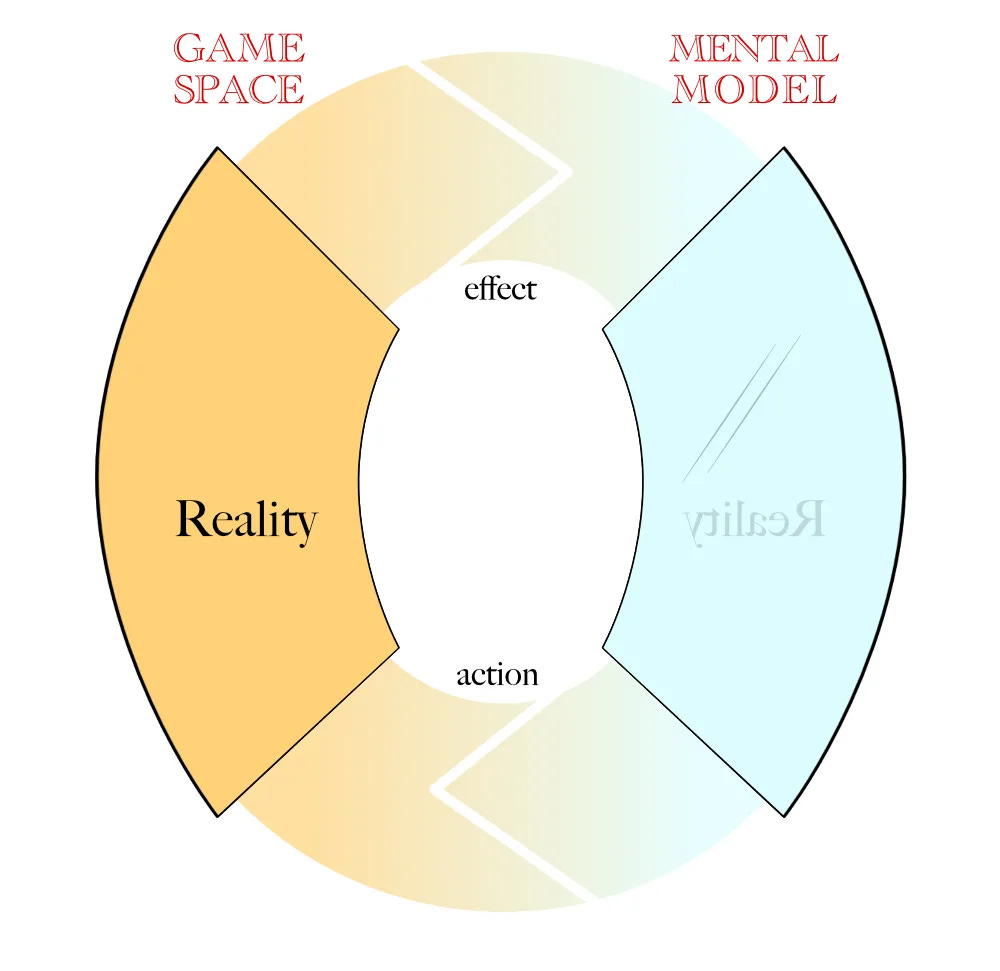
Continuously presenting information that is either new or changes the situation works well in books and films to keep the audience mentally engaged. Games, however, add another crucial element: interactivity.
Once players have processed information and formed a plan, they can put the plan into action. That act of participation increases engagement. The point of the circular process—the loop—is not that the same loop repeats endlessly adding to itself, but that many loops are running simultaneously, often feeding into or replacing one another. An action resolved with a dice roll may change the game state; that change may evoke an emotional response in a player, and that response may prompt new actions from the other participants.
Players are constantly evaluating different kinds of questions. For example:
The fictional model: What is happening in the world?
The thematic model: What is this story really about?
The social model: What do the other participants want?
The game model: How do the rules work?
The self model: How do I show myself as an individual?
The important point is that these models are interconnected, each reinforcing the others to create the overall play experience. An action produces an effect, which in turn produces another action.
The game designer or game master can deliberately encourage certain types of player actions by creating particular effects within the game world. A situation that connects to a character’s background or personal relationships, for example, naturally invites that player to become even more involved.
Every roleplaying game relies on the same underlying cognitive loop. What differs between play styles is which mental models are emphasized and which aspects of those models receive the greatest attention.
If an action requires a dice roll, it will be uncertain what will happen next. The dice mechanics become an effect in their own right. The game master may have clearly established the stakes of failure or presented alternative approaches the player can try if the roll fails. Those outcomes create new effects, new decisions, and the loop continues.
Even in games with perfect information, it is impossible to predict exactly what will happen, because different players interpret the same information differently. Their interpretations are shaped by their preferred play styles, their characters, and by what they believe will create the most enjoyable experience for the group. In this way, the players themselves become a source of uncertainty within the game—whether they are moving pieces across a board, interpreting clues in a mystery, allocating resources, or roleplaying dialogue to develop relationships between fictional characters.
In this series:
Beyond Rules and Fiction: What Makes Games Different From Stories
Beyond Rules and Fiction: A Diagnostic Tool for Debugging Engagement
Beyond Rules and Fiction: The Future of Roleplaying Game Design